
Distinctive Assets: How Brands Build Memory, Recognition, and Sales

# Distinctive Assets: How Brands Build Memory, Recognition, and Sales
---
#The shelf does not reward subtlety
Walk into any supermarket. You have 3 seconds before the shopper's hand moves. Three seconds to register, recognise, and remind them why they trust you. Most brands burn those seconds being tasteful.
Tasteful does not sell. Recognisable sells.
The cruel maths: a shopper walks past 30,000+ SKUs in an average store. Your pack gets a glance, not a study. If they can't pin you in half a second, you lost the sale to a competitor with a louder colour, a bolder shape, or a weirder mascot.
This article is about the cheapest growth lever in marketing that almost nobody is pulling properly. Distinctive assets. The stuff that makes a brand findable, memorable, and ultimately, sellable.
---
> **TL;DR**
> Distinctive assets are the colours, shapes, sounds, characters, and signatures that make a brand instantly recognisable, even with the logo stripped off. Byron Sharp proved they drive growth more reliably than positioning. Most brands underbuild them, then over-protect them with rigid guidelines that kill versatility. The brands that win build a wide toolkit and let it flex across every touchpoint.
---
### Most brands are not forgotten because they are bad
They are forgotten because they look like everyone else.
In FMCG, the average shopper recalls roughly 3 brands per category unprompted. Three. Out of dozens. If you're not in that mental shortlist, your media budget is buying awareness that evaporates the moment they enter the store.
The reason most brands miss the shortlist is not bad product. It's that they built a brand without distinctive assets. They have a logo, a font, a colour palette pulled from a 2019 Pinterest board, and a tagline nobody remembers. **That is not a brand. That is a stationery kit.**
---
### The idea that quietly rewired modern marketing
In 2010, Professor Byron Sharp and the Ehrenberg-Bass Institute released *How Brands Grow*. It did to marketing what Moneyball did to baseball.
The core argument: brands grow by reaching more people, more often, with more recognisability, not by positioning themselves into a narrow tribe. Differentiation is mostly an illusion. **Distinctiveness is the real game.**
His follow-up work with Jenni Romaniuk gave us the formal framework: Distinctive Brand Assets. The non-brand-name elements (colour, shape, character, sound, packaging cue) that trigger the brand in the consumer's mind faster than any tagline ever could.
Most marketers nod and then ignore it. They keep chasing "purpose" and "story" while their pack still looks like everything else in the aisle.
---
### Distinctive assets are buying shortcuts
The brain does not want to think at the shelf. It wants to recognise and move on.
Distinctive assets are the brain's shortcut. Tiffany Blue tells you "luxury jewellery" before you read a word. The Toblerone shape tells you "premium chocolate from somewhere fancy." The McDonald's golden arches work at 100 metres in any language.
These are not decoration. They are commerce. They reduce friction at the moment of purchase, which is the only moment that matters.
If your brand requires a shopper to read to recognise it, you've already lost. **Reading is failure. Recognition is the sale.**
---
### Pringles, Coke & Heineken: 3 brands that don't need their logo to sell
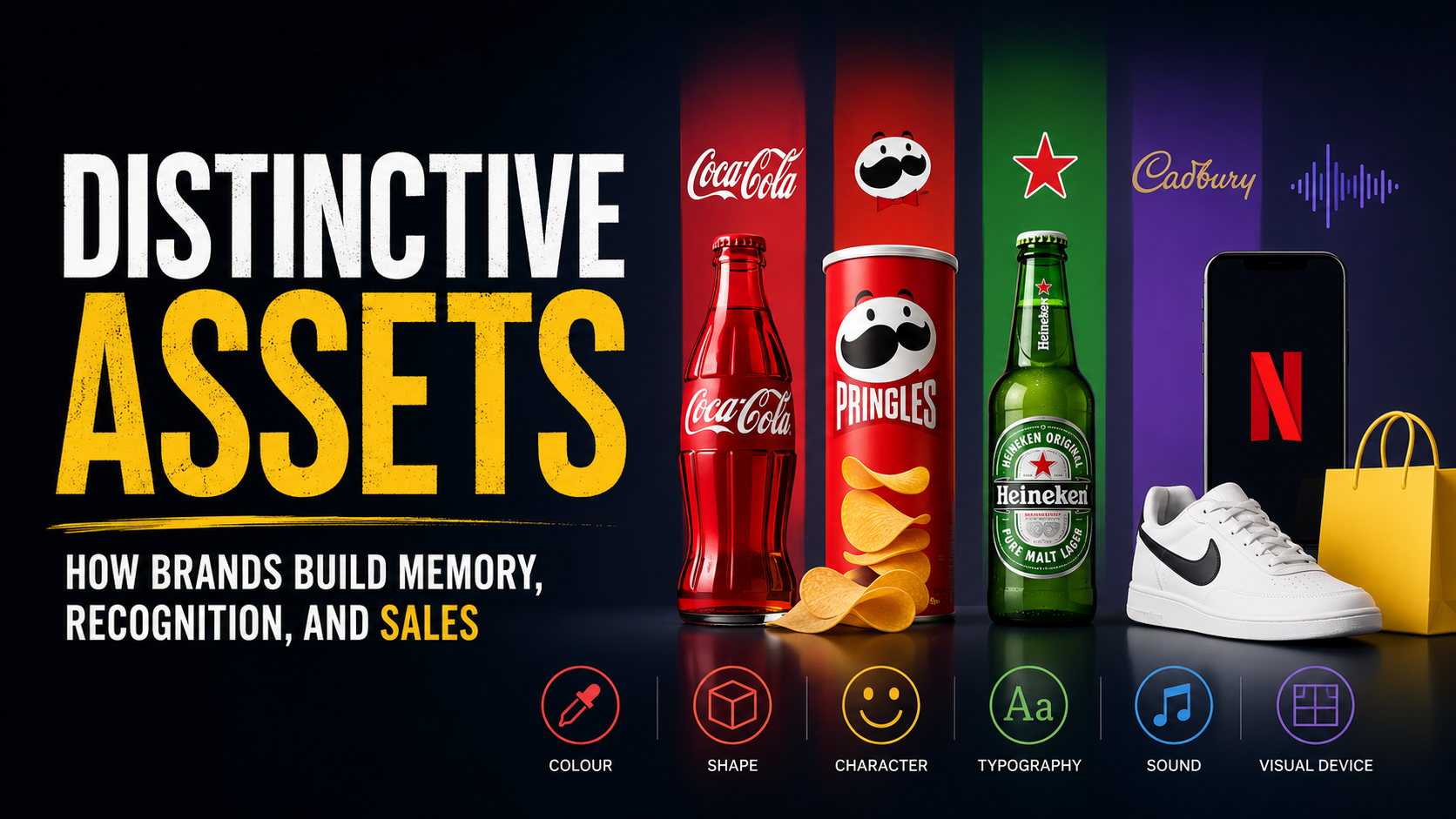
**Pringles.** The tube. Nobody else uses it. Cover the logo, blur the mascot, and a 6-year-old still tells you it's Pringles. The shape is the brand. The crisp shape inside the shape (stacked, identical, saddle-curved) is the brand inside the brand.
**Coca-Cola.** Strip the logo. You still have: the contour bottle, Coke Red, the dynamic ribbon, the Spencerian script, the polar bear, the sonic mnemonic. Six assets, any one of which alone signals Coke. That is asset depth.
**Heineken.** Green bottle. Red star. White-on-green wordmark. The "e" tilted at a smile. Across 190+ countries, the green-and-red combination does 80% of the work before a word of advertising lands.
What these three have in common: none of them rely on the logo alone. **The logo is one asset in a portfolio. The portfolio is the brand.**
---
### 6 distinctive assets most worth owning
Ranked by what actually moves units at shelf and screen.
1. **Colour.** The fastest mental shortcut. Cadbury Purple. Tiffany Blue. UPS Brown. Owning a colour at the category level is the single biggest equity move you can make.
2. **Pack shape / silhouette.** Coke contour, Toblerone prism, Absolut bottle. Shape is recognisable from 10 metres in a way no graphic ever is.
3. **Character / mascot.** Tony the Tiger, the Michelin Man, the Geico Gecko. Characters outperform faceless brands on recall by 30 to 40% in long-running studies.
4. **Typography / wordmark.** Coca-Cola's script, Disney's signature, FedEx's hidden arrow. When the letters themselves are the brand, you can't be copied.
5. **Sound / sonic logo.** The Intel chime, the Netflix "ta-dum", the McDonald's "ba da ba ba ba". Worth more than most logos and a fraction of the cost to build.
6. **Repeated visual device.** The Burberry check, the Nike swoosh placement, the Adidas three stripes. Patterns scale across every touchpoint without ever needing a logo.
**If you own 2 of these, you're a brand. If you own 4+, you're an empire.**
---
### Does your brand have distinctive assets? A quick audit
Five questions. Answer honestly.
1. If I strip your logo and tagline off your pack, can a shopper still name you in 2 seconds?
2. Do you own a colour at the category level, or are you sharing it with three competitors?
3. Does your brand have a sound? A character? A signature shape? A repeated device?
4. Could a junior designer recreate your brand using just the toolkit, without ever opening the guidelines doc?
5. Has your brand looked recognisably itself for at least 5 years?
Score: 0–1 yes means you have a logo, not a brand. 2–3 means you have foundations. 4–5 means you have real equity and you should be defending it.
**Most brands I audit score 1.**
---
### The killer mistake that hurts 90% of rebrands
Refreshing for the sake of refreshing.
Every 3 to 5 years, a new CMO arrives. They want a stamp. They commission a rebrand. The agency, sensing a fee, agrees the brand "needs to evolve." The colours shift, the wordmark gets a haircut, the mascot is "modernised."
What just happened? You torched the recognition equity you spent millions building.
Tropicana lost around $30M in sales in 2 months when they rebranded their packaging in 2009 and dropped the iconic orange-with-a-straw. They reverted. The damage was done.
**Refresh the execution. Never abandon the asset.** Gap learned the same lesson in 2010 when their 6-day logo change ended in public reversal. The market does not want your evolution. It wants to find you.
---
### How to redesign for success — build a brand asset toolkit
Pack is your most-used media channel. Start there.
Every brand should be redesigned not as a logo plus a 60-page guidelines PDF, but as a toolkit of distinctive assets that travel together. Colour, shape, character, type, sound, device. Each one designed to work alone and in combination.
Here's the real test of a toolkit: can your agency build 50 different executions across pack, OOH, digital, retail, sonic, and motion, where every single one feels unmistakably you, without ever repeating the same composition?
If yes, you have a toolkit. If no, you have a logo and a hope.
This is where most rebrands die. They deliver a beautiful keynote. Then the brand hits 12 freelancers, 4 production agencies, and 3 markets. Within 18 months, it looks like 18 different brands. **Toolkit thinking prevents that.**
---
### Distinctive assets compound — if applied correctly
Most marketing spend depreciates. The TVC stops running, the influencer post slides off the feed, the campaign ends.
Distinctive assets do the opposite. Every impression builds on the last. Year 1, the colour is noise. Year 5, the colour is the brand. Year 20, the colour is the category. **Tiffany Blue did not happen in a campaign. It happened in a century of consistency.**
This is the part most CFOs do not understand and most CMOs cannot defend. Distinctive assets are an investment with compounding returns, not a line item to cut when the quarter looks shaky.
The brands that win this game decide on their assets early, commit to them obsessively, and resist the urge to change them every time leadership turns over. That commitment is the moat.
---
### Don't forget: versatility beats consistency
The classic brand guidelines doctrine: "be consistent." Use the logo this way. Spacing this much. Same composition every time.
That doctrine made sense in 1995. In 2026, it is a recipe for invisibility.
The modern shopper sees your brand on TikTok, a shelf, a billboard, a delivery box, a retail screen, and a podcast intro in the same hour. If every touchpoint looks identical, you are wallpaper. If every touchpoint mixes the same assets in different ways, you are everywhere.
The new doctrine: **consistent signature, infinite variety.** Same colour, different layouts. Same character, different roles. Same sound, different remixes.
The brands still applying 1995 hyper-consistency are losing share to brands that have learned to flex. Build the toolkit. Trust the toolkit. Let it dance.
---
### Closing
Distinctive assets are not a creative exercise. They are a commercial decision.
The brands that win the next decade will not be the ones with the cleverest taglines or the most lyrical purpose statements. They will be the ones a shopper recognises in half a second, on any screen, in any context, with or without their logo attached.
Audit your assets. Build the toolkit. Defend it. Let it travel.
What's the one asset your brand could own at the category level, that you are currently sharing with three competitors?