
The Rise of Microbrands Small brands are no longer staying small For decades, scale was the moat.

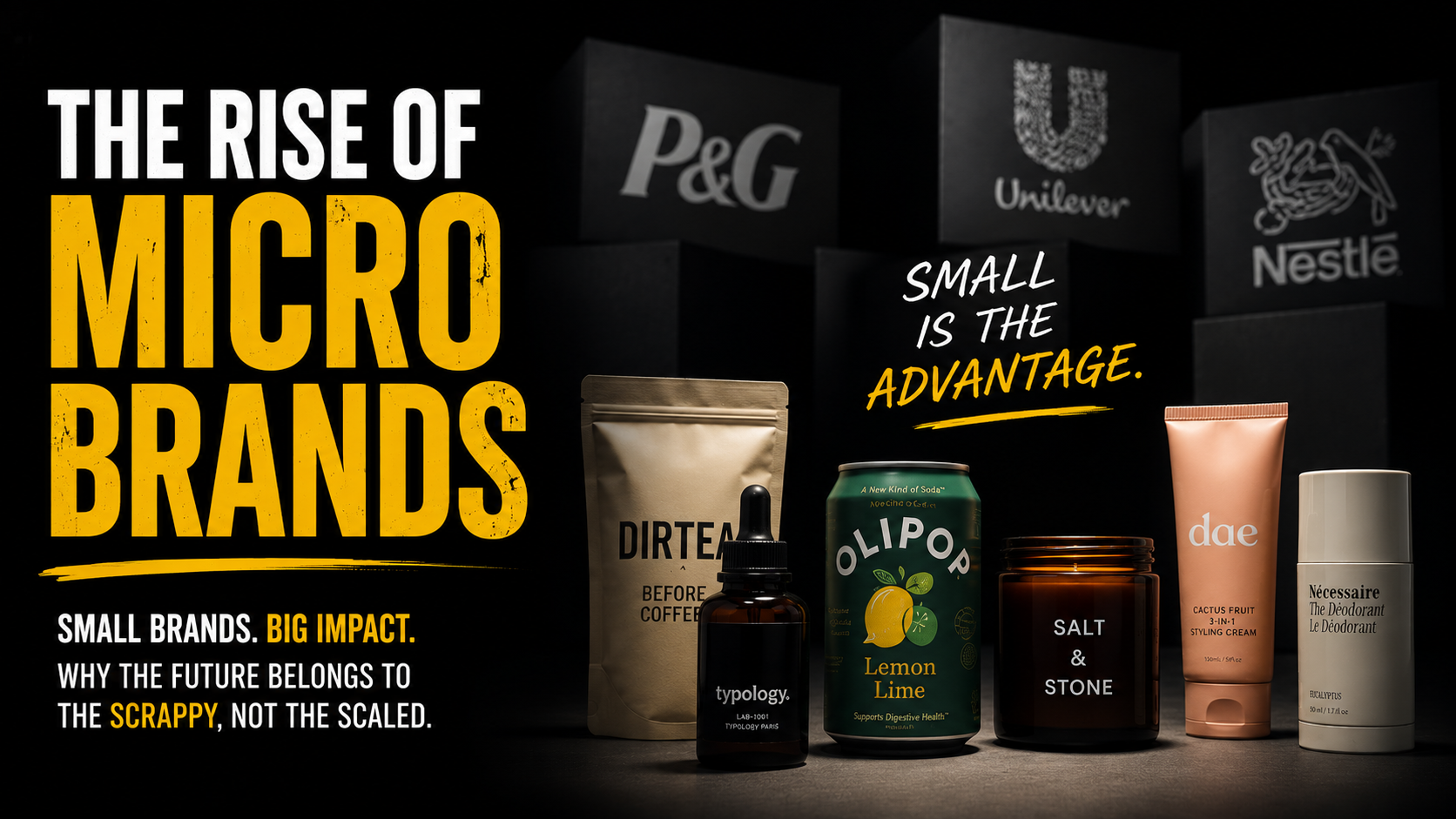
The Rise of Microbrands
Small brands are no longer staying small
The giants won because they could manufacture cheaper, distribute wider, advertise louder, and survive longer than everyone else. If you wanted to launch a consumer brand in 1995, you needed factories, retail relationships, agency retainers, and enough capital to survive a brutal fight for shelf space.
Most challengers died before the customer even saw them.
Then the internet broke distribution.
Now a 4-person team with a Shopify account, strong packaging, and one viral TikTok can outsell companies that spent twenty years building retail dominance.
This is the rise of the microbrand.
Small, highly focused brands built for niche audiences, digital-first discovery, and cultural relevance instead of mass-market scale. They are not trying to become the next Unilever on day one. They are trying to own a very specific corner of attention.
And increasingly, they are winning.
Not because they are bigger.
Because they are faster.
The old model was built for scarcity
Historically, brand growth depended on access.
Access to media. Access to shelves. Access to manufacturing. Access to distribution.
Television advertising alone acted as a moat. Most small brands simply could not afford visibility. Shelf space worked the same way. Large retailers preferred large suppliers because reliability mattered more than experimentation.
The result was predictable.
Big brands became bigger because the system itself rewarded scale.
But digital commerce changed the equation.
You no longer need permission to exist.
You can launch a brand tomorrow. You can manufacture in small batches. You can advertise directly through social platforms. You can build audiences before products. You can sell globally before entering a single physical store.
The barriers collapsed.
That does not mean building brands became easy.
It means the game changed.
Microbrands do not sell products. They sell identity.
The biggest misunderstanding about microbrands is assuming they compete through price.
They rarely do.
Most microbrands win because they feel culturally sharper than legacy players.
The customer is not buying soap. They are buying aesthetic.
Not coffee. Identity.
Not skincare. Belonging.
Large corporations are built to optimise consistency. Microbrands are built to optimise emotional relevance.
That difference matters.
A global FMCG company needs mass appeal. A microbrand only needs intense appeal within a small audience.
That intensity creates loyalty.
And loyalty creates margins.
This is why consumers will happily spend more on a niche matcha brand in minimalist packaging than a cheaper supermarket alternative sitting three feet away.
The product matters.
But the signal matters more.
The internet rewards specificity
Mass marketing was designed for broadcast media.
The internet rewards narrowcasting.
Algorithms do not care about broad demographic targeting anymore. They care about engagement.
Which means highly specific brands suddenly have unfair advantages.
A microbrand built around cycling culture, Korean skincare routines, sustainable pet food, mushroom coffee, or minimalist parenting can dominate its niche because the algorithm keeps feeding it directly to the exact people most likely to care.
Large brands struggle here.
Not because they lack resources.
Because they lack sharpness.
Corporate messaging tends to smooth itself into generic language designed to offend nobody.
Microbrands do the opposite.
They pick a tribe.
Then they speak its language obsessively.
That focus feels authentic because it usually is.
Many microbrands are founded by people who genuinely belong to the culture they are selling into.
That credibility is difficult for large organisations to imitate.
Packaging became media
One of the biggest reasons microbrands exploded is that packaging itself became content.
Historically, packaging was designed mainly for shelf visibility.
Today, packaging also lives on Instagram, TikTok, YouTube unboxings, and customer-generated content.
Your customer is no longer just consuming the product.
They are broadcasting it.
This changed the economics of design.
A beautiful package is no longer a cost.
It is distribution.
Brands like Glossier, Liquid Death, Graza, and countless niche DTC startups understood this early. Their products were designed to be photographed.
The packaging became the advertisement.
That is an enormous shift.
It means small brands can now generate visibility organically through design systems that encourage sharing.
The shelf still matters.
But now the shelf is also social media.
Speed is becoming more valuable than scale
Large organisations optimise for risk reduction.
Microbrands optimise for speed.
That difference is becoming lethal.
A traditional corporation might take twelve months to develop, approve, manufacture, and launch a new product.
A microbrand can test five concepts in the same period.
This matters because culture now moves faster than most corporate systems.
Trends emerge overnight. Consumer language evolves weekly. Aesthetic movements appear and disappear within months.
Speed is no longer operational advantage.
It is strategic survival.
The brands winning today are often the ones capable of reacting fastest to shifts in attention.
Not the ones with the biggest annual budget.
Microbrands understand modern trust
Consumers increasingly distrust polished corporate messaging.
Especially younger audiences.
They grew up inside advertising saturation. They recognise performance branding instantly.
Microbrands often feel more human because they are closer to the founder, closer to the customer, and closer to the community.
People trust people more than institutions.
That sounds obvious.
Yet many large brands still communicate like legal departments wearing sneakers.
Microbrands behave differently.
They show behind-the-scenes content. They embrace imperfection. They respond directly to comments. They involve customers in development. They speak casually instead of corporately.
The result feels less manufactured.
Ironically, that perception itself becomes a competitive asset.
Most large brands are structurally bad at internet culture
The internet rewards participation.
Large companies are built around control.
Those two things collide constantly.
Microbrands thrive because they can move inside culture naturally. They can make jokes quickly. They can experiment without committee approval. They can sound like actual humans.
Meanwhile, legacy brands often produce content that feels reverse-engineered by compliance teams.
Safe.
Polished.
Forgettable.
The problem is not intelligence.
It is structure.
Large organisations are designed to protect existing equity.
Microbrands are designed to gain attention.
Different incentives create different behaviours.
And in a digital environment driven by engagement, attention tends to outperform caution.
Retail is changing because discovery changed
Retail used to create discovery.
Now discovery often happens before retail.
Customers arrive already informed.
They saw the product online. They watched reviews. They saw creators use it. They joined the hype cycle before stepping into a store.
This reverses the traditional funnel.
Retail no longer introduces the brand.
Retail validates the brand.
That shift benefits microbrands enormously because they can build demand digitally before negotiating physical distribution.
Large retailers increasingly want digitally proven brands because the audience already exists.
Shelf space is becoming downstream of attention.
Not the other way around.
Most microbrands will still fail
This part gets ignored.
The rise of microbrands does not mean every niche startup becomes a billion-dollar company.
Most will disappear.
Because branding alone is not enough.
Product quality still matters. Operations matter. Supply chains matter. Margins matter. Retention matters.
The internet lowered the barrier to entry.
It also increased competition dramatically.
Consumers now face endless options.
That means many microbrands succeed at generating initial hype but fail to build durable memory.
Attention without systems eventually collapses.
This is where many founders confuse virality with brand building.
They are not the same thing.
Virality creates spikes.
Brands create repeat behaviour.
The companies that survive long term are the ones that convert cultural relevance into operational resilience.
That transition is difficult.
The future belongs to portfolio ecosystems
Ironically, many large corporations are adapting by buying microbrands instead of competing directly.
Why?
Because microbrands are now functioning as cultural R&D departments.
They move faster. They detect trends earlier. They connect with emerging consumer behaviours before corporations even notice the shift.
Acquisition became the shortcut.
Big companies increasingly operate like portfolio managers rather than singular master brands.
This is likely the future.
Not one giant brand dominating everything.
But ecosystems of smaller, culturally specific brands operating under larger operational infrastructure.
Consumers want specificity.
Corporations want scale.
Portfolio models deliver both.
Distinctiveness matters even more for small brands
One mistake many microbrands make is confusing aesthetic trends with brand assets.
Minimalism alone is not a strategy.
Neither is beige packaging.
If your brand looks identical to every other startup in the category, you disappear.
The same rules still apply.
Distinctiveness matters.
In fact, it matters even more when budgets are small.
The strongest microbrands understand this instinctively.
They build recognisable packaging. Recognisable tone. Recognisable community language. Recognisable visual systems.
The goal is not merely to look premium.
The goal is to become memorable.
That difference separates real brands from temporary aesthetics.
Closing
The rise of microbrands is not a trend.
It is the logical outcome of what happens when distribution fragments, algorithms reward specificity, and consumers begin valuing identity as much as utility.
The giants are not disappearing.
But the monopoly of scale is.
The next decade will belong to brands capable of moving quickly, speaking culturally, and building emotional relevance within highly specific communities.
Not every brand needs to be massive anymore.
It just needs to matter deeply to the right people.
And increasingly, that is enough.