
How Gen Z and Gen Alpha Connect Differently with Brands

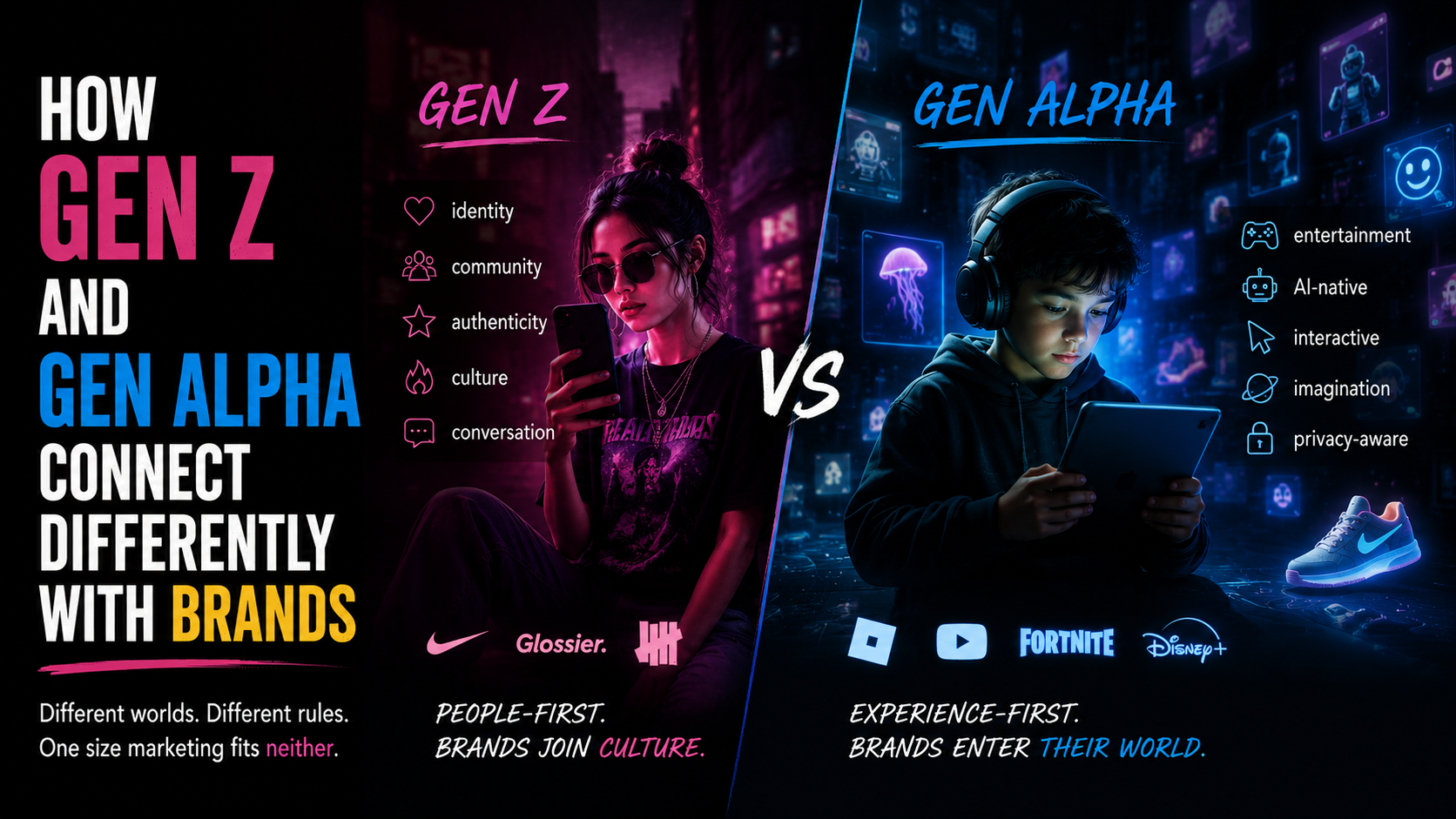
How Gen Z and Gen Alpha Connect Differently with Brands
The next generation of consumers did not grow up in the same internet
Marketers keep talking about Gen Z and Gen Alpha like they are the same audience.
They are not.
One grew up during the rise of social media.
The other was born inside algorithmic reality.
That difference changes everything.
Gen Z remembers transition. Gen Alpha only knows immersion.
Gen Z watched the internet become culture.
Gen Alpha assumes culture is the internet.
Brands treating them identically are already behind.
Because the way these generations discover, trust, interact with, and emotionally connect to brands is fundamentally different.
And the gap is widening faster than most marketers realise.
_______________________________________
Gen Z grew up curating identity
Gen Z came of age during the explosion of Instagram, YouTube, Snapchat, and early TikTok.
The internet for them was social-first.
Profiles mattered. Personal branding mattered. Aesthetic identity mattered.
This generation learned to express themselves publicly online.
That shaped how they connect with brands.
For Gen Z, brands function as identity signals.
What you wear, drink, use, stream, and post says something about who you are.
This is why Gen Z gravitates toward brands with strong values, cultural positioning, and aesthetic coherence.
They do not just buy products.
They buy association.
The brand becomes part of self-expression.
This is also why authenticity became such an overused marketing buzzword.
Because Gen Z developed highly sensitive radar for performance.
They grew up watching influencer culture evolve in real time.
They know when something feels manufactured.
Or worse.
Desperate.
_______________________________________
Gen Alpha is growing up inside algorithmic entertainment
Gen Alpha interacts with the internet differently.
They are not browsing.
They are being fed.
TikTok, YouTube Shorts, Roblox, AI recommendations, personalised feeds, gaming ecosystems, and endless algorithmic content streams shaped their digital environment from birth.
Their experience of media is less intentional and more immersive.
This generation is growing up in a world where discovery is automatic.
The algorithm decides what matters.
That changes how brands compete.
For Gen Alpha, visibility is not about being followed.
It is about being surfaced.
Which means brands increasingly need to behave like entertainment systems instead of advertising systems.
This generation does not separate content, gaming, creators, memes, and commerce neatly.
Everything blends together.
The brand is not interrupting the experience.
The brand is expected to be part of the experience.
_______________________________________
Gen Z values alignment. Gen Alpha values engagement.
This is one of the most important distinctions.
Gen Z often connects with brands through values.
Sustainability. Inclusivity. Ethics. Mental health. Social positioning.
Whether fully genuine or partially performative, those signals matter because Gen Z sees consumption as an extension of identity.
Gen Alpha behaves differently.
They are less interested in ideological alignment and more interested in stimulation.
Does it entertain me?
Can I interact with it?
Can I customise it?
Can I remix it?
Can I play with it?
Gen Alpha expects participation.
Static brands will struggle with them.
_______________________________________
Attention spans did not collapse. Standards increased.
One of the laziest narratives in marketing is claiming younger generations have no attention span.
That is not true.
They have no patience for boredom.
There is a difference.
Gen Z and Gen Alpha can both spend hours consuming content.
But the content must earn attention immediately.
These generations grew up inside infinite-scroll competition.
Every piece of content fights against millions of alternatives.
That environment trained them to filter aggressively.
Brands therefore face a brutal reality.
You are no longer competing against your category.
You are competing against everything.
Netflix.
TikTok.
Gaming.
Creators.
Memes.
Group chats.
The entire internet.
Which means modern branding increasingly behaves like entertainment architecture.
Not traditional advertising.
_______________________________________
Gen Z still separates creators and brands
Mostly.
Gen Alpha often does not.
Gen Z witnessed the rise of influencer culture from the beginning. They still distinguish between corporate messaging and creator-driven content.
Gen Alpha is growing up in blended environments where creators, platforms, avatars, games, AI personalities, and brands coexist fluidly.
To them, a Roblox activation, a virtual skin, a creator collaboration, and a product launch may all feel like part of the same ecosystem.
This changes brand strategy dramatically.
The old campaign model is weakening.
Future brand systems will likely behave more like persistent digital worlds than isolated advertising bursts.
Brands are becoming ongoing environments.
Not just messages.
_______________________________________
Community matters differently now
Gen Z helped normalise online communities.
Discord groups. Fandoms. Niche TikTok circles. Digital subcultures.
Community became central to internet identity.
But Gen Alpha is taking this even further.
For them, digital interaction is not secondary socialisation.
It is socialisation.
Gaming spaces, creator ecosystems, virtual experiences, and online collaboration are integrated directly into everyday life.
That means brands capable of facilitating interaction gain enormous emotional advantage.
The future strongest brands may look less like companies and more like participation platforms.
People increasingly want to belong around brands, not merely purchase from them.
________________________________________________________________________________
Aesthetic literacy is now universal
Younger generations consume enormous volumes of visual content daily.
As a result, their aesthetic expectations are significantly higher than previous generations.
Bad branding stands out immediately.
Cheap design signals low credibility.
Generic content gets ignored instantly.
This creates pressure on brands to operate with cultural and visual sharpness at all times.
Especially online.
Because every touchpoint now acts as branding.
Packaging.
Comments.
Captions.
Motion.
Memes.
UI design.
Everything communicates.
The brands winning younger audiences understand this intuitively.
They build cohesive worlds instead of isolated advertisements.
_______________________________________
The biggest mistake brands make with younger audiences
Trying too hard.
Nothing collapses credibility faster.
Gen Z and Gen Alpha both grew up around highly mediated digital behaviour. They recognise forced relevance instantly.
When brands chase slang awkwardly, mimic meme culture poorly, or insert themselves artificially into conversations, the reaction is usually brutal.
The internet punishes desperation.
The strongest brands therefore do something surprisingly simple.
They understand their role.
Not every brand needs to behave like a comedian.
Not every brand should try to become culturally viral.
The brands that win tend to understand where they naturally fit inside the consumer's world.
Then they execute consistently.
_______________________________________
Future brands will behave more like media companies
This shift is already happening.
The line between brand, entertainment, creator, platform, and community is dissolving.
Future successful brands will likely need:
• Content ecosystems
• Creator partnerships
• Community infrastructure
• Interactive experiences
• Personalisation systems
• Digital environments
• Ongoing narrative worlds
In other words, branding itself is becoming more dynamic.
Not static identity.
Living systems.
This evolution matters especially for Gen Alpha because they are growing up expecting interactivity by default.
Passive consumption increasingly feels outdated.
_______________________________________
Closing
Gen Z and Gen Alpha are not simply younger consumers.
They are products of entirely different digital environments.
Gen Z connects with brands through identity, values, and cultural alignment.
Gen Alpha connects through immersion, participation, and algorithmic engagement.
One generation learned to express itself online.
The next generation is growing up inside digital ecosystems where the boundary between entertainment, commerce, creators, and brands barely exists anymore.
The companies that succeed over the next decade will not merely advertise to younger audiences.
They will build environments people want to participate in.
Because increasingly, the strongest brands are not being watched.
They are being lived inside.