Building Brand in an AI Era AI is about to flood the world with average content

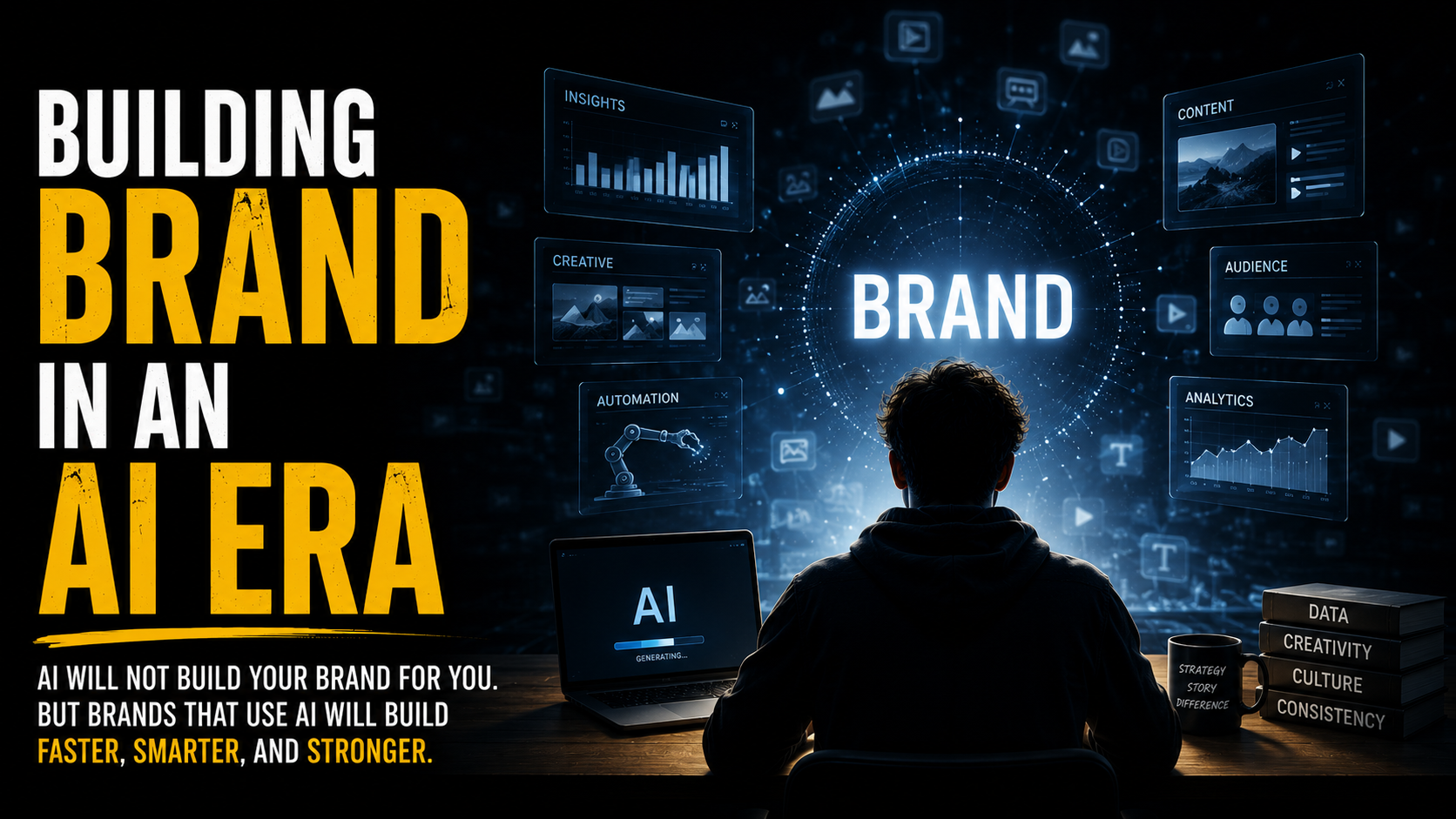
Building Brand in an AI Era
AI is about to flood the world with average content
This is the part most marketers still do not fully understand.
AI is not just another productivity tool.
It is a content multiplier.
An enormous one.
Over the next few years, brands will generate more ads, more visuals, more copy, more videos, more campaigns, and more automated communication than at any point in history.
The cost of producing content is collapsing.
Which sounds exciting.
Until you realise what happens when everyone gains the same capability simultaneously.
The internet fills with noise.
Not because AI makes bad marketing.
Because AI makes average marketing infinitely easier to produce.
And when average becomes abundant, distinctiveness becomes priceless.
_______________________________________
The scarcity has shifted
Historically, production capacity created advantage.
The companies capable of producing more content, buying more media, and operating larger creative teams usually dominated attention.
AI changes that equation.
Execution is becoming commoditised.
The new scarcity is no longer production.
It is taste.
Judgement.
Strategy.
Distinctiveness.
Creative direction.
In other words, the tools are democratising.
Which means brand itself matters more than ever.
Because when everyone can generate content quickly, consumers need stronger signals to decide what deserves attention.
_______________________________________
Most AI-generated marketing will look the same
This is already happening.
Scroll LinkedIn for five minutes.
The same polished graphics.
The same sterile copy.
The same motivational tone.
The same hyper-clean AI aesthetics.
The same recycled structures.
AI systems are trained on existing patterns.
Which means average inputs tend to produce average outputs.
That creates a dangerous future for brands relying purely on efficiency.
Because optimisation without identity eventually leads to sameness.
And sameness destroys memory.
The brands that survive the AI era will not be the ones generating the most content.
They will be the ones generating the most recognisable content.
_______________________________________
Distinctive assets become survival systems
In a saturated AI environment, distinctive assets stop being optional.
They become navigation tools.
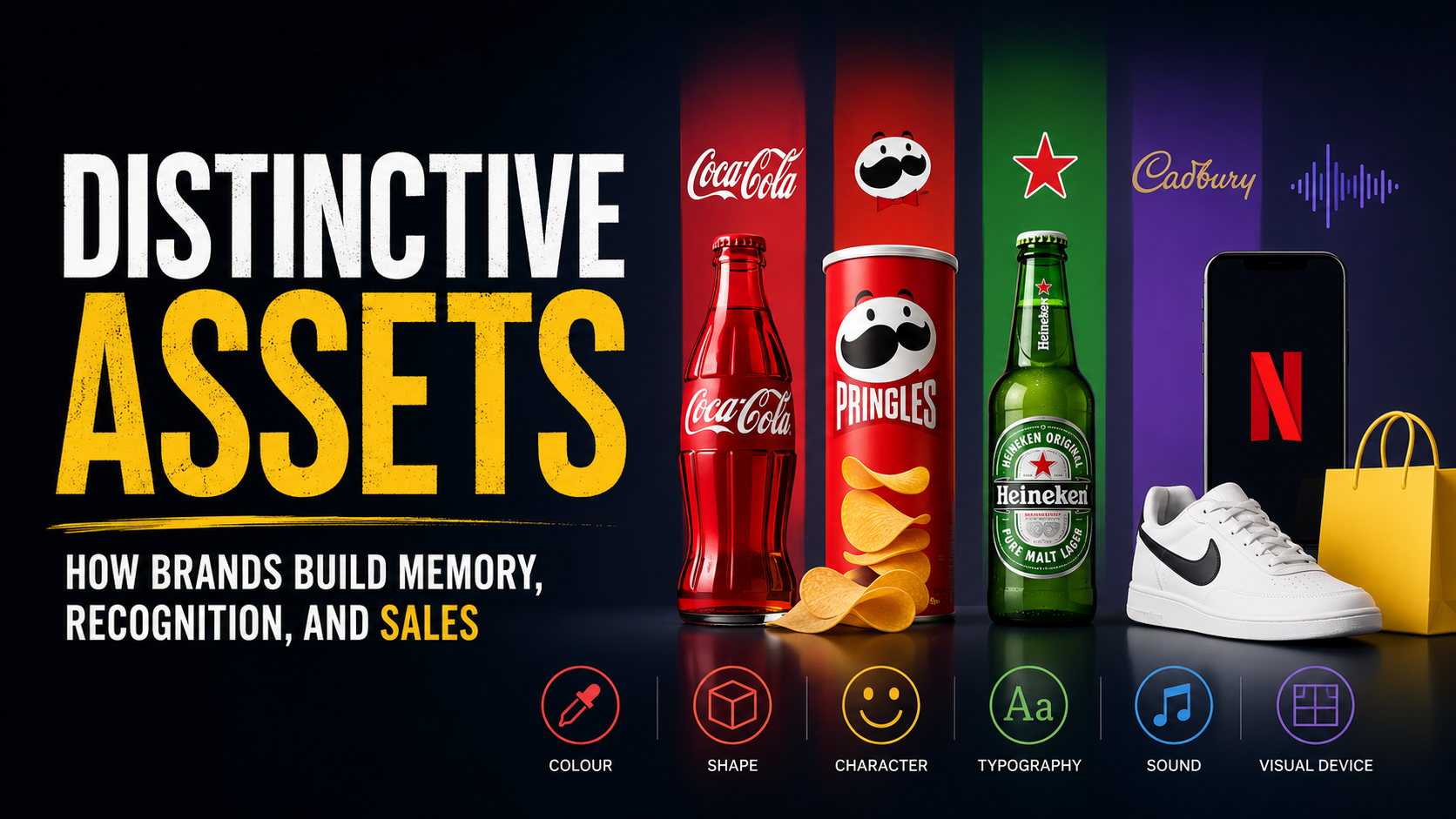
Consumers will increasingly rely on recognisable colours, visual systems, tone of voice, sonic branding, mascots, typography, and recurring creative devices to filter overwhelming volumes of content.
Recognition reduces cognitive load.
That matters enormously when feeds become infinitely crowded.
This is why the strongest future brands will likely behave less like campaign machines and more like highly consistent sensory systems.
Every touchpoint reinforcing memory.
Every asset strengthening recall.
The brands with weak identity systems will disappear into the algorithmic blur.
_______________________________________
AI increases the value of human taste
Ironically, AI may elevate human creativity rather than replace it.
Because the bottleneck shifts.
Generating ideas becomes easy.
Choosing the right ones becomes difficult.
The future competitive advantage is not prompt writing.
It is creative judgement.
Knowing what feels culturally sharp.
Knowing what feels emotionally resonant.
Knowing what should not be generated.
That last point matters.
Restraint is becoming a premium skill.
Just because brands can produce endless content does not mean they should.
Volume without meaning accelerates irrelevance.
_______________________________________
Brand consistency is evolving
Traditional brand guidelines were built for slower media environments.
Fixed layouts.
Fixed logo rules.
Fixed executions.
AI changes the scale and speed of adaptation.
Brands now need systems capable of producing enormous variation while still feeling unmistakably recognisable.
That is a different challenge.
The future belongs to flexible identity systems.
Consistent signature.
Infinite execution.
The core assets stay stable.
The outputs become dynamic.
This is especially important because AI-generated media will increasingly personalise itself in real time.
Consumers may see entirely different versions of the same brand depending on platform, context, behaviour, and preference.
Without strong underlying identity systems, fragmentation becomes inevitable.
_______________________________________
AI will not fix weak strategy
Many companies secretly hope AI will compensate for mediocre branding.
It will not.
AI amplifies whatever system already exists.
Strong brands become more scalable.
Weak brands become more efficiently forgettable.
If your positioning is unclear, AI scales confusion.
If your visual identity lacks distinction, AI multiplies sameness.
If your communication feels generic, AI produces generic faster.
Technology does not solve strategic weakness.
It exposes it.
_______________________________________
Human connection still matters
One interesting paradox of the AI era is that human signals may become more valuable precisely because synthetic content increases.
Consumers will increasingly look for proof of humanity.
Founder visibility.
Behind-the-scenes content.
Real voices.
Community interaction.
Imperfection.
Not because people reject AI entirely.
But because trust becomes more important when artificial production becomes widespread.
This creates an unusual future where brands simultaneously become more technologically sophisticated and more emotionally human.
The strongest companies will balance both.
_______________________________________
The internet is entering synthetic media overload
AI-generated video, AI-generated influencers, AI-generated images, AI-generated music, AI-generated voices, AI-generated articles.
The volume will become overwhelming.
This changes consumer psychology.
People adapt to abundance by filtering harder.
Attention becomes even more selective.
Which means emotional clarity matters more.
Brands must communicate faster.
Sharper.
More recognisably.
The middle ground becomes dangerous.
Forgettable brands will vanish quickest because there is simply too much competing material.
_______________________________________
Creativity is shifting from production to orchestration
This may be the biggest transformation of all.
Historically, creative work involved manual execution.
Designing.
Writing.
Editing.
Animating.
Producing.
Increasingly, creative leadership will involve orchestration.
Directing systems.
Combining tools.
Curating outputs.
Building coherent brand worlds across enormous volumes of generated material.
The role of the creative person does not disappear.
It evolves.
Much like photography did not kill art.
And digital music did not eliminate musicians.
The tools change.
Taste remains.
_______________________________________
The brands that win will feel unmistakably themselves
This is the core lesson.
In an environment where content becomes cheap, identity becomes expensive.
The future strongest brands will likely share several traits:
• Strong distinctive assets
• Clear strategic positioning
• Recognisable tone of voice
• Flexible but coherent design systems
• Human emotional signals
• Cultural awareness
• High creative judgement
Not because AI replaces branding.
Because AI intensifies the importance of branding.
_______________________________________
Closing
The AI era is not killing creativity.
It is killing average.
Brands can now generate more content than ever before.
But consumers are also filtering more aggressively than ever before.
That means future growth will not come from volume alone.
It will come from recognisability.
Clarity.
Taste.
Distinctiveness.
The brands that thrive over the next decade will not simply use AI efficiently.
They will use it while remaining unmistakably human.
Because when every company can generate infinite communication, the rarest thing left is a brand people actually remember.