Influencers x Brands

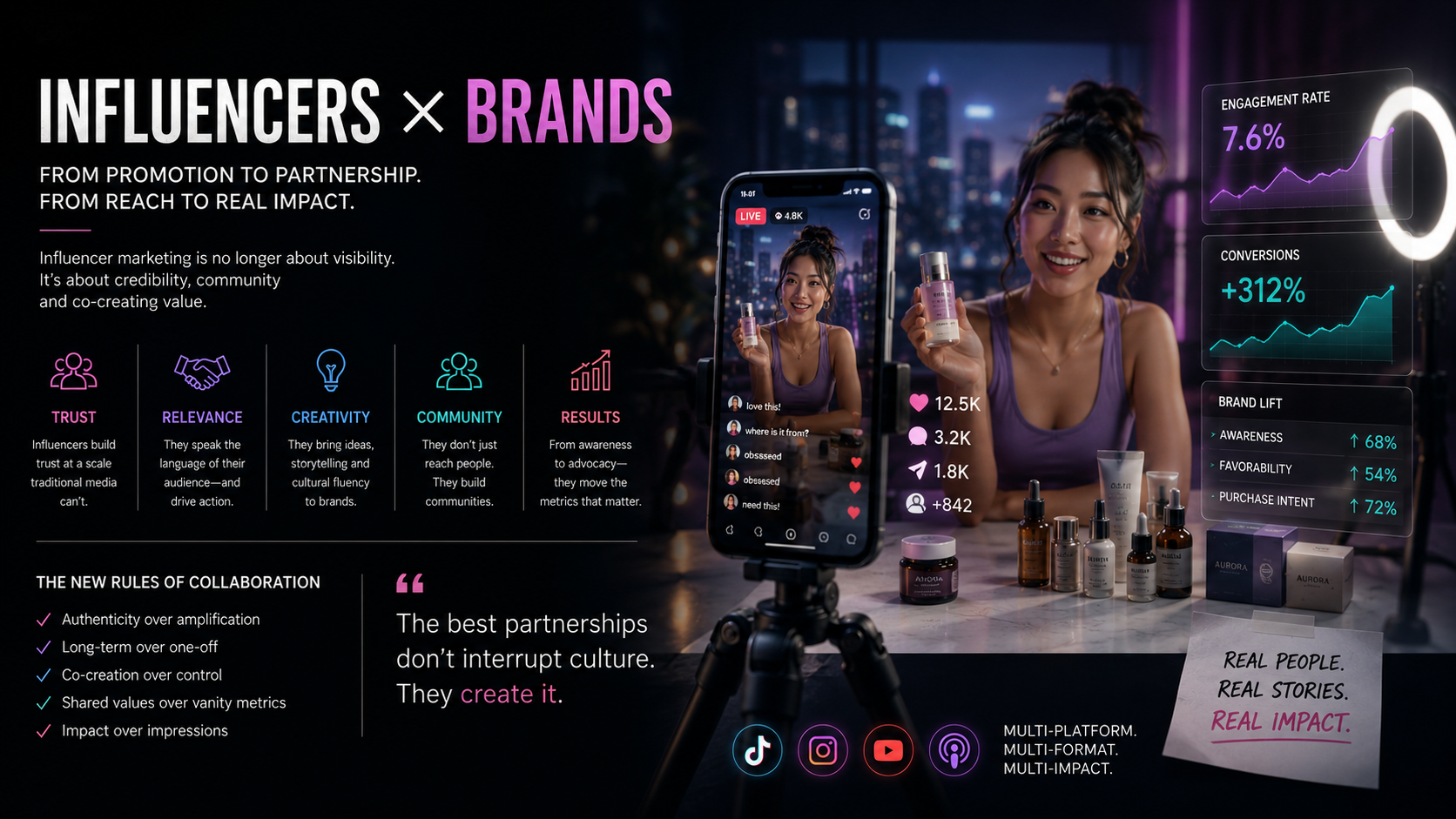
Influencers x Brands
Influencers are no longer media channels
This is where many companies still misunderstand the creator economy.
Influencers are not merely advertising placements anymore.
They are media brands.
Cultural distributors.
Trust systems.
Entertainment ecosystems.
In some cases, more powerful than traditional publishers.
For years, brands approached influencers like rented attention.
Pay for post.
Track impressions.
Measure engagement.
Move on.
That model still exists.
But the creator economy evolved far beyond campaign mechanics.
Today, creators increasingly shape purchasing behaviour, aesthetic trends, language, cultural relevance, and even product development itself.
The relationship between influencers and brands is no longer tactical.
It is structural.
_______________________________________
Trust fragmented away from institutions
Historically, large institutions controlled public influence.
Television networks.
Magazines.
Celebrities.
Publishers.
Brands themselves.
Social media fragmented that system.
Consumers increasingly trust individuals more than corporations.
Especially younger audiences.
Creators feel human.
Immediate.
Relatable.
Consistent.
Audiences follow them daily.
Sometimes for years.
That repeated exposure creates intimacy.
And intimacy creates persuasion.
This is why creator recommendations often outperform polished corporate advertising dramatically.
The message feels socially transferred rather than commercially delivered.
That distinction matters.
_______________________________________
Influence became infrastructure
Many industries now rely heavily on creators for discovery.
Beauty.
Fashion.
Food.
Technology.
Fitness.
Travel.
Gaming.
Books.
Even finance.
Consumers increasingly encounter products through creator ecosystems before encountering traditional advertising.
This reverses historical marketing flow.
The creator often introduces the brand first.
The brand validates later.
Which means creators now operate as discovery infrastructure.
Not merely amplification.
_______________________________________
The strongest creators behave like brands
Ironically, the best influencers increasingly resemble companies.
Distinctive visual identity.
Recognisable tone.
Audience positioning.
Community behaviour.
Merchandise.
Products.
Recurring content systems.
The strongest creators build emotional consistency over time.
That consistency generates loyalty.
Which eventually converts into economic power.
Many creators are now launching:
• Beverage brands
• Skincare brands
• Fashion labels
• Supplements
• Technology products
• Education platforms
Because audience ownership became more valuable than media buying.
_______________________________________
Most brand collaborations still feel transactional
This remains one of the biggest weaknesses in influencer marketing.
Too many partnerships still feel obviously commercial.
Forced scripts.
Awkward integration.
Overcontrolled messaging.
Audiences recognise this instantly.
The strongest creator-brand relationships feel native to the creator’s existing world.
The product fits naturally.
The communication style remains authentic.
The creator retains creative control.
That flexibility matters enormously because creators understand their audience dynamics better than most brand managers do.
_______________________________________
Attention is shifting from polished to personal
Traditional advertising optimised polish.
Creators optimise connection.
That is why low-production creator content often outperforms expensive campaigns.
Consumers increasingly prioritise:
• Relatability
• Personality
• Realness
• Entertainment
• Emotional immediacy
Over corporate perfection.
This does not mean quality disappeared.
It means emotional realism became more persuasive than visual polish alone.
Brands still operating entirely through traditional advertising language increasingly feel distant online.
_______________________________________
The algorithm changed influence economics
Historically, celebrities required mass visibility.
Today algorithms can create micro-celebrities at enormous scale.
Niche influence became commercially viable.
A creator with 50,000 highly engaged followers may now outperform a celebrity with millions of passive followers.
Why?
Because specificity creates trust.
And trust drives conversion.
This fundamentally changes how brands should think about partnerships.
Mass reach alone is becoming less important than audience relevance.
_______________________________________
Influencers are becoming product collaborators
The relationship is evolving again.
Brands increasingly involve creators earlier in development.
Not just promotion.
Because creators understand audience psychology in real time.
They receive immediate behavioural feedback daily.
Comments.
Questions.
Engagement patterns.
Trend signals.
This makes creators surprisingly valuable as cultural intelligence systems.
Many companies still underestimate this.
They treat creators as distribution.
When increasingly they should also be treated as insight infrastructure.
_______________________________________
The future belongs to ecosystem partnerships
One-off sponsorships are weakening.
Long-term ecosystem relationships are strengthening.
The strongest future partnerships will likely involve:
• Product co-creation
• Community integration
• Shared storytelling
• Ongoing collaboration
• Audience participation
• Event experiences
• Platform ecosystems
Why?
Because audiences increasingly prefer continuity.
Not isolated campaigns.
Brands behaving like temporary guests inside creator worlds feel forgettable.
Brands contributing consistently to those worlds feel culturally embedded.
That difference matters.
_______________________________________
Creators are replacing parts of traditional advertising
Not completely.
But meaningfully.
Large campaign production still matters.
Brand building still matters.
Mass media still matters.
But creators increasingly dominate:
• Discovery
• Recommendation
• Cultural relevance
• Product education
• Community behaviour
• Trend acceleration
Which means modern marketing systems increasingly require hybrid structures.
Traditional brand strategy combined with creator-native execution.
The companies understanding this balance earliest will likely dominate attention.
_______________________________________
Closing
The creator economy is no longer a side channel.
It became one of the central operating systems of modern consumer culture.
Influencers now shape discovery, trust, purchasing behaviour, aesthetics, and identity at global scale.
The brands that succeed in this environment will not treat creators like rented billboards.
They will treat them like cultural partners.
Because increasingly, influence itself became infrastructure.
And the future of branding belongs to the companies capable of participating naturally inside the communities where attention already lives.