
INSIGHT
Distinctive Assets: How Brands Build Memory, Recognition, and Sales
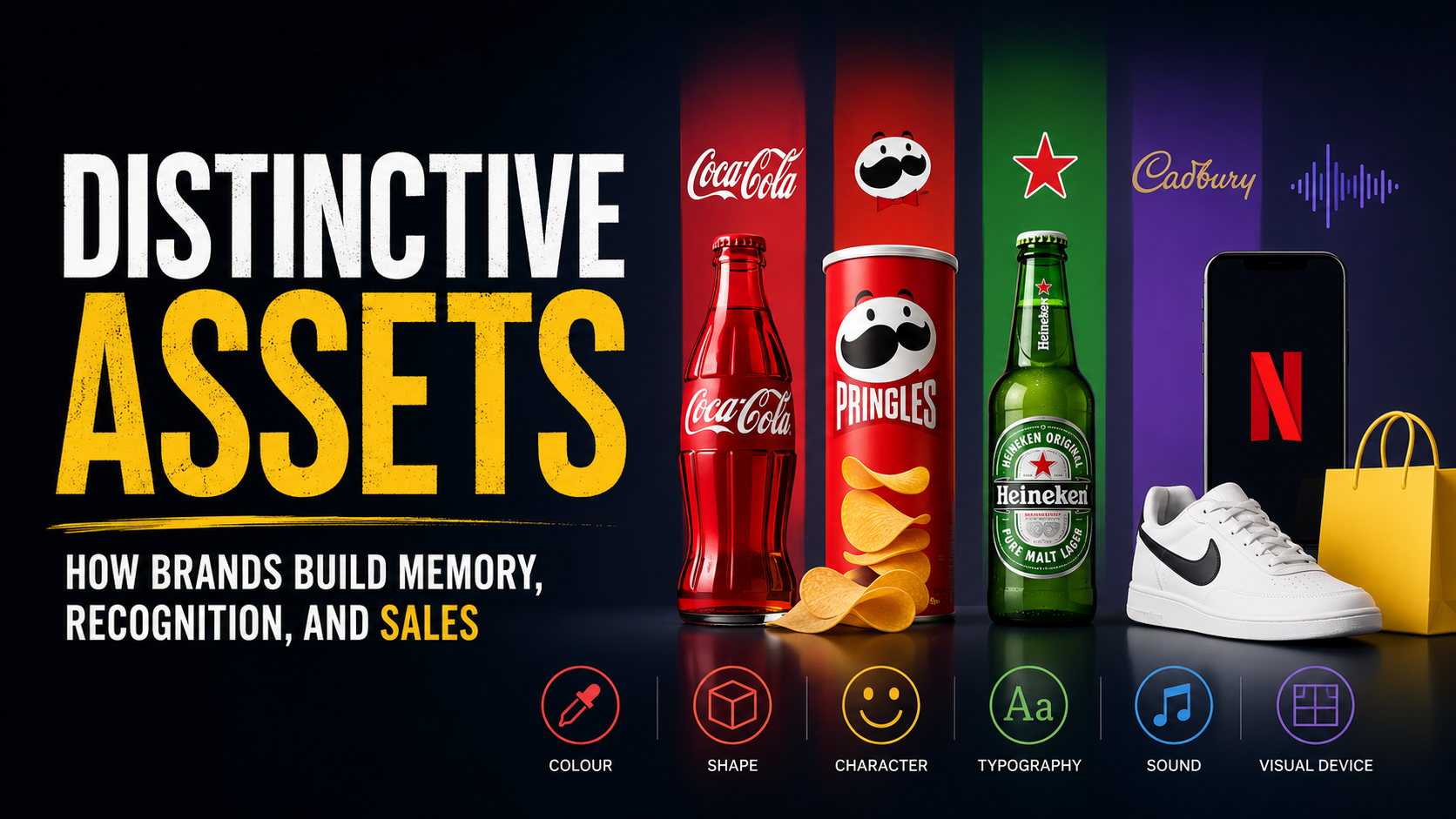
# Distinctive Assets: How Brands Build Memory, Recognition, and Sales --- #The shelf does not reward subtlety Walk into any supermarket. You have 3 seconds before the shopper's hand moves. Three seconds to register, recognise, and remind them why they trust you. Most brands burn those seconds being tasteful. Tasteful does not sell. Recognisable sells. The cruel maths: a shopper walks past 30,000+ SKUs in an average store. Your pack gets a glance, not a study. If they can't pin you in half a second, you lost the sale to a competitor with a louder colour, a bolder shape, or a weirder mascot. This article is about the cheapest growth lever in marketing that almost nobody is pulling properly. Distinctive assets. The stuff that makes a brand findable, memorable, and ultimately, sellable. --- > **TL;DR** > Distinctive assets are the colours, shapes, sounds, characters, and signatures that make a brand instantly recognisable, even with the logo stripped off. Byron Sharp proved they drive growth more reliably than positioning. Most brands underbuild them, then over-protect them with rigid guidelines that kill versatility. The brands that win build a wide toolkit and let it flex across every touchpoint. --- ### Most brands are not forgotten because they are bad They are forgotten because they look like everyone else. In FMCG, the average shopper recalls roughly 3 brands per category unprompted. Three. Out of dozens. If you're not in that mental shortlist, your media budget is buying awareness that evaporates the moment they enter the store. The reason most brands miss the shortlist is not bad product. It's that they built a brand without distinctive assets. They have a logo, a font, a colour palette pulled from a 2019 Pinterest board, and a tagline nobody remembers. **That is not a brand. That is a stationery kit.** --- ### The idea that quietly rewired modern marketing In 2010, Professor Byron Sharp and the Ehrenberg-Bass Institute released *How Brands Grow*. It did to marketing what Moneyball did to baseball. The core argument: brands grow by reaching more people, more often, with more recognisability, not by positioning themselves into a narrow tribe. Differentiation is mostly an illusion. **Distinctiveness is the real game.** His follow-up work with Jenni Romaniuk gave us the formal framework: Distinctive Brand Assets. The non-brand-name elements (colour, shape, character, sound, packaging cue) that trigger the brand in the consumer's mind faster than any tagline ever could. Most marketers nod and then ignore it. They keep chasing "purpose" and "story" while their pack still looks like everything else in the aisle. --- ### Distinctive assets are buying shortcuts The brain does not want to think at the shelf. It wants to recognise and move on. Distinctive assets are the brain's shortcut. Tiffany Blue tells you "luxury jewellery" before you read a word. The Toblerone shape tells you "premium chocolate from somewhere fancy." The McDonald's golden arches work at 100 metres in any language. These are not decoration. They are commerce. They reduce friction at the moment of purchase, which is the only moment that matters. If your brand requires a shopper to read to recognise it, you've already lost. **Reading is failure. Recognition is the sale.** --- ### Pringles, Coke & Heineken: 3 brands that don't need their logo to sell **Pringles.** The tube. Nobody else uses it. Cover the logo, blur the mascot, and a 6-year-old still tells you it's Pringles. The shape is the brand. The crisp shape inside the shape (stacked, identical, saddle-curved) is the brand inside the brand. **Coca-Cola.** Strip the logo. You still have: the contour bottle, Coke Red, the dynamic ribbon, the Spencerian script, the polar bear, the sonic mnemonic. Six assets, any one of which alone signals Coke. That is asset depth. **Heineken.** Green bottle. Red star. White-on-green wordmark. The "e" tilted at a smile. Across 190+ countries, the green-and-red combination does 80% of the work before a word of advertising lands. What these three have in common: none of them rely on the logo alone. **The logo is one asset in a portfolio. The portfolio is the brand.** --- ### 6 distinctive assets most worth owning Ranked by what actually moves units at shelf and screen. 1. **Colour.** The fastest mental shortcut. Cadbury Purple. Tiffany Blue. UPS Brown. Owning a colour at the category level is the single biggest equity move you can make. 2. **Pack shape / silhouette.** Coke contour, Toblerone prism, Absolut bottle. Shape is recognisable from 10 metres in a way no graphic ever is. 3. **Character / mascot.** Tony the Tiger, the Michelin Man, the Geico Gecko. Characters outperform faceless brands on recall by 30 to 40% in long-running studies. 4. **Typography / wordmark.** Coca-Cola's script, Disney's signature, FedEx's hidden arrow. When the letters themselves are the brand, you can't be copied. 5. **Sound / sonic logo.** The Intel chime, the Netflix "ta-dum", the McDonald's "ba da ba ba ba". Worth more than most logos and a fraction of the cost to build. 6. **Repeated visual device.** The Burberry check, the Nike swoosh placement, the Adidas three stripes. Patterns scale across every touchpoint without ever needing a logo. **If you own 2 of these, you're a brand. If you own 4+, you're an empire.** --- ### Does your brand have distinctive assets? A quick audit Five questions. Answer honestly. 1. If I strip your logo and tagline off your pack, can a shopper still name you in 2 seconds? 2. Do you own a colour at the category level, or are you sharing it with three competitors? 3. Does your brand have a sound? A character? A signature shape? A repeated device? 4. Could a junior designer recreate your brand using just the toolkit, without ever opening the guidelines doc? 5. Has your brand looked recognisably itself for at least 5 years? Score: 0–1 yes means you have a logo, not a brand. 2–3 means you have foundations. 4–5 means you have real equity and you should be defending it. **Most brands I audit score 1.** --- ### The killer mistake that hurts 90% of rebrands Refreshing for the sake of refreshing. Every 3 to 5 years, a new CMO arrives. They want a stamp. They commission a rebrand. The agency, sensing a fee, agrees the brand "needs to evolve." The colours shift, the wordmark gets a haircut, the mascot is "modernised." What just happened? You torched the recognition equity you spent millions building. Tropicana lost around $30M in sales in 2 months when they rebranded their packaging in 2009 and dropped the iconic orange-with-a-straw. They reverted. The damage was done. **Refresh the execution. Never abandon the asset.** Gap learned the same lesson in 2010 when their 6-day logo change ended in public reversal. The market does not want your evolution. It wants to find you. --- ### How to redesign for success — build a brand asset toolkit Pack is your most-used media channel. Start there. Every brand should be redesigned not as a logo plus a 60-page guidelines PDF, but as a toolkit of distinctive assets that travel together. Colour, shape, character, type, sound, device. Each one designed to work alone and in combination. Here's the real test of a toolkit: can your agency build 50 different executions across pack, OOH, digital, retail, sonic, and motion, where every single one feels unmistakably you, without ever repeating the same composition? If yes, you have a toolkit. If no, you have a logo and a hope. This is where most rebrands die. They deliver a beautiful keynote. Then the brand hits 12 freelancers, 4 production agencies, and 3 markets. Within 18 months, it looks like 18 different brands. **Toolkit thinking prevents that.** --- ### Distinctive assets compound — if applied correctly Most marketing spend depreciates. The TVC stops running, the influencer post slides off the feed, the campaign ends. Distinctive assets do the opposite. Every impression builds on the last. Year 1, the colour is noise. Year 5, the colour is the brand. Year 20, the colour is the category. **Tiffany Blue did not happen in a campaign. It happened in a century of consistency.** This is the part most CFOs do not understand and most CMOs cannot defend. Distinctive assets are an investment with compounding returns, not a line item to cut when the quarter looks shaky. The brands that win this game decide on their assets early, commit to them obsessively, and resist the urge to change them every time leadership turns over. That commitment is the moat. --- ### Don't forget: versatility beats consistency The classic brand guidelines doctrine: "be consistent." Use the logo this way. Spacing this much. Same composition every time. That doctrine made sense in 1995. In 2026, it is a recipe for invisibility. The modern shopper sees your brand on TikTok, a shelf, a billboard, a delivery box, a retail screen, and a podcast intro in the same hour. If every touchpoint looks identical, you are wallpaper. If every touchpoint mixes the same assets in different ways, you are everywhere. The new doctrine: **consistent signature, infinite variety.** Same colour, different layouts. Same character, different roles. Same sound, different remixes. The brands still applying 1995 hyper-consistency are losing share to brands that have learned to flex. Build the toolkit. Trust the toolkit. Let it dance. --- ### Closing Distinctive assets are not a creative exercise. They are a commercial decision. The brands that win the next decade will not be the ones with the cleverest taglines or the most lyrical purpose statements. They will be the ones a shopper recognises in half a second, on any screen, in any context, with or without their logo attached. Audit your assets. Build the toolkit. Defend it. Let it travel. What's the one asset your brand could own at the category level, that you are currently sharing with three competitors?
 MAY 24, 2026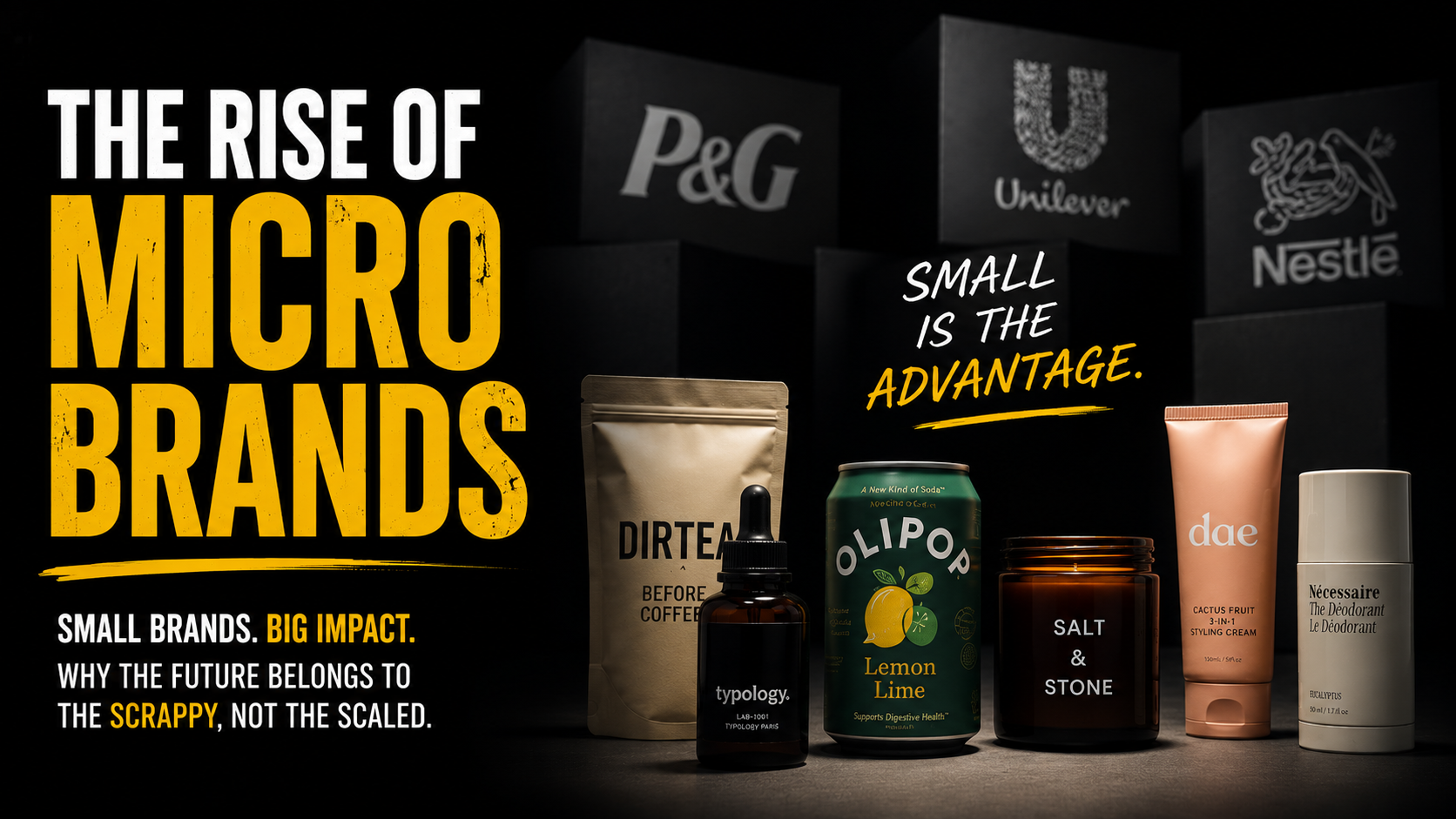
The Rise of Microbrands Small brands are no longer staying small For decades, scale was the moat.
The Rise of Microbrands Small brands are no longer staying small The giants won because they could manufacture cheaper, distribute wider, advertise louder, and survive longer than everyone else. If you wanted to launch a consumer brand in 1995, you needed factories, retail relationships, agency retainers, and enough capital to survive a brutal fight for shelf space. Most challengers died before the customer even saw them. Then the internet broke distribution. Now a 4-person team with a Shopify account, strong packaging, and one viral TikTok can outsell companies that spent twenty years building retail dominance. This is the rise of the microbrand. Small, highly focused brands built for niche audiences, digital-first discovery, and cultural relevance instead of mass-market scale. They are not trying to become the next Unilever on day one. They are trying to own a very specific corner of attention. And increasingly, they are winning. Not because they are bigger. Because they are faster. The old model was built for scarcity Historically, brand growth depended on access. Access to media. Access to shelves. Access to manufacturing. Access to distribution. Television advertising alone acted as a moat. Most small brands simply could not afford visibility. Shelf space worked the same way. Large retailers preferred large suppliers because reliability mattered more than experimentation. The result was predictable. Big brands became bigger because the system itself rewarded scale. But digital commerce changed the equation. You no longer need permission to exist. You can launch a brand tomorrow. You can manufacture in small batches. You can advertise directly through social platforms. You can build audiences before products. You can sell globally before entering a single physical store. The barriers collapsed. That does not mean building brands became easy. It means the game changed. Microbrands do not sell products. They sell identity. The biggest misunderstanding about microbrands is assuming they compete through price. They rarely do. Most microbrands win because they feel culturally sharper than legacy players. The customer is not buying soap. They are buying aesthetic. Not coffee. Identity. Not skincare. Belonging. Large corporations are built to optimise consistency. Microbrands are built to optimise emotional relevance. That difference matters. A global FMCG company needs mass appeal. A microbrand only needs intense appeal within a small audience. That intensity creates loyalty. And loyalty creates margins. This is why consumers will happily spend more on a niche matcha brand in minimalist packaging than a cheaper supermarket alternative sitting three feet away. The product matters. But the signal matters more. The internet rewards specificity Mass marketing was designed for broadcast media. The internet rewards narrowcasting. Algorithms do not care about broad demographic targeting anymore. They care about engagement. Which means highly specific brands suddenly have unfair advantages. A microbrand built around cycling culture, Korean skincare routines, sustainable pet food, mushroom coffee, or minimalist parenting can dominate its niche because the algorithm keeps feeding it directly to the exact people most likely to care. Large brands struggle here. Not because they lack resources. Because they lack sharpness. Corporate messaging tends to smooth itself into generic language designed to offend nobody. Microbrands do the opposite. They pick a tribe. Then they speak its language obsessively. That focus feels authentic because it usually is. Many microbrands are founded by people who genuinely belong to the culture they are selling into. That credibility is difficult for large organisations to imitate. Packaging became media One of the biggest reasons microbrands exploded is that packaging itself became content. Historically, packaging was designed mainly for shelf visibility. Today, packaging also lives on Instagram, TikTok, YouTube unboxings, and customer-generated content. Your customer is no longer just consuming the product. They are broadcasting it. This changed the economics of design. A beautiful package is no longer a cost. It is distribution. Brands like Glossier, Liquid Death, Graza, and countless niche DTC startups understood this early. Their products were designed to be photographed. The packaging became the advertisement. That is an enormous shift. It means small brands can now generate visibility organically through design systems that encourage sharing. The shelf still matters. But now the shelf is also social media. Speed is becoming more valuable than scale Large organisations optimise for risk reduction. Microbrands optimise for speed. That difference is becoming lethal. A traditional corporation might take twelve months to develop, approve, manufacture, and launch a new product. A microbrand can test five concepts in the same period. This matters because culture now moves faster than most corporate systems. Trends emerge overnight. Consumer language evolves weekly. Aesthetic movements appear and disappear within months. Speed is no longer operational advantage. It is strategic survival. The brands winning today are often the ones capable of reacting fastest to shifts in attention. Not the ones with the biggest annual budget. Microbrands understand modern trust Consumers increasingly distrust polished corporate messaging. Especially younger audiences. They grew up inside advertising saturation. They recognise performance branding instantly. Microbrands often feel more human because they are closer to the founder, closer to the customer, and closer to the community. People trust people more than institutions. That sounds obvious. Yet many large brands still communicate like legal departments wearing sneakers. Microbrands behave differently. They show behind-the-scenes content. They embrace imperfection. They respond directly to comments. They involve customers in development. They speak casually instead of corporately. The result feels less manufactured. Ironically, that perception itself becomes a competitive asset. Most large brands are structurally bad at internet culture The internet rewards participation. Large companies are built around control. Those two things collide constantly. Microbrands thrive because they can move inside culture naturally. They can make jokes quickly. They can experiment without committee approval. They can sound like actual humans. Meanwhile, legacy brands often produce content that feels reverse-engineered by compliance teams. Safe. Polished. Forgettable. The problem is not intelligence. It is structure. Large organisations are designed to protect existing equity. Microbrands are designed to gain attention. Different incentives create different behaviours. And in a digital environment driven by engagement, attention tends to outperform caution. Retail is changing because discovery changed Retail used to create discovery. Now discovery often happens before retail. Customers arrive already informed. They saw the product online. They watched reviews. They saw creators use it. They joined the hype cycle before stepping into a store. This reverses the traditional funnel. Retail no longer introduces the brand. Retail validates the brand. That shift benefits microbrands enormously because they can build demand digitally before negotiating physical distribution. Large retailers increasingly want digitally proven brands because the audience already exists. Shelf space is becoming downstream of attention. Not the other way around. Most microbrands will still fail This part gets ignored. The rise of microbrands does not mean every niche startup becomes a billion-dollar company. Most will disappear. Because branding alone is not enough. Product quality still matters. Operations matter. Supply chains matter. Margins matter. Retention matters. The internet lowered the barrier to entry. It also increased competition dramatically. Consumers now face endless options. That means many microbrands succeed at generating initial hype but fail to build durable memory. Attention without systems eventually collapses. This is where many founders confuse virality with brand building. They are not the same thing. Virality creates spikes. Brands create repeat behaviour. The companies that survive long term are the ones that convert cultural relevance into operational resilience. That transition is difficult. The future belongs to portfolio ecosystems Ironically, many large corporations are adapting by buying microbrands instead of competing directly. Why? Because microbrands are now functioning as cultural R&D departments. They move faster. They detect trends earlier. They connect with emerging consumer behaviours before corporations even notice the shift. Acquisition became the shortcut. Big companies increasingly operate like portfolio managers rather than singular master brands. This is likely the future. Not one giant brand dominating everything. But ecosystems of smaller, culturally specific brands operating under larger operational infrastructure. Consumers want specificity. Corporations want scale. Portfolio models deliver both. Distinctiveness matters even more for small brands One mistake many microbrands make is confusing aesthetic trends with brand assets. Minimalism alone is not a strategy. Neither is beige packaging. If your brand looks identical to every other startup in the category, you disappear. The same rules still apply. Distinctiveness matters. In fact, it matters even more when budgets are small. The strongest microbrands understand this instinctively. They build recognisable packaging. Recognisable tone. Recognisable community language. Recognisable visual systems. The goal is not merely to look premium. The goal is to become memorable. That difference separates real brands from temporary aesthetics. Closing The rise of microbrands is not a trend. It is the logical outcome of what happens when distribution fragments, algorithms reward specificity, and consumers begin valuing identity as much as utility. The giants are not disappearing. But the monopoly of scale is. The next decade will belong to brands capable of moving quickly, speaking culturally, and building emotional relevance within highly specific communities. Not every brand needs to be massive anymore. It just needs to matter deeply to the right people. And increasingly, that is enough.
MAY 24, 2026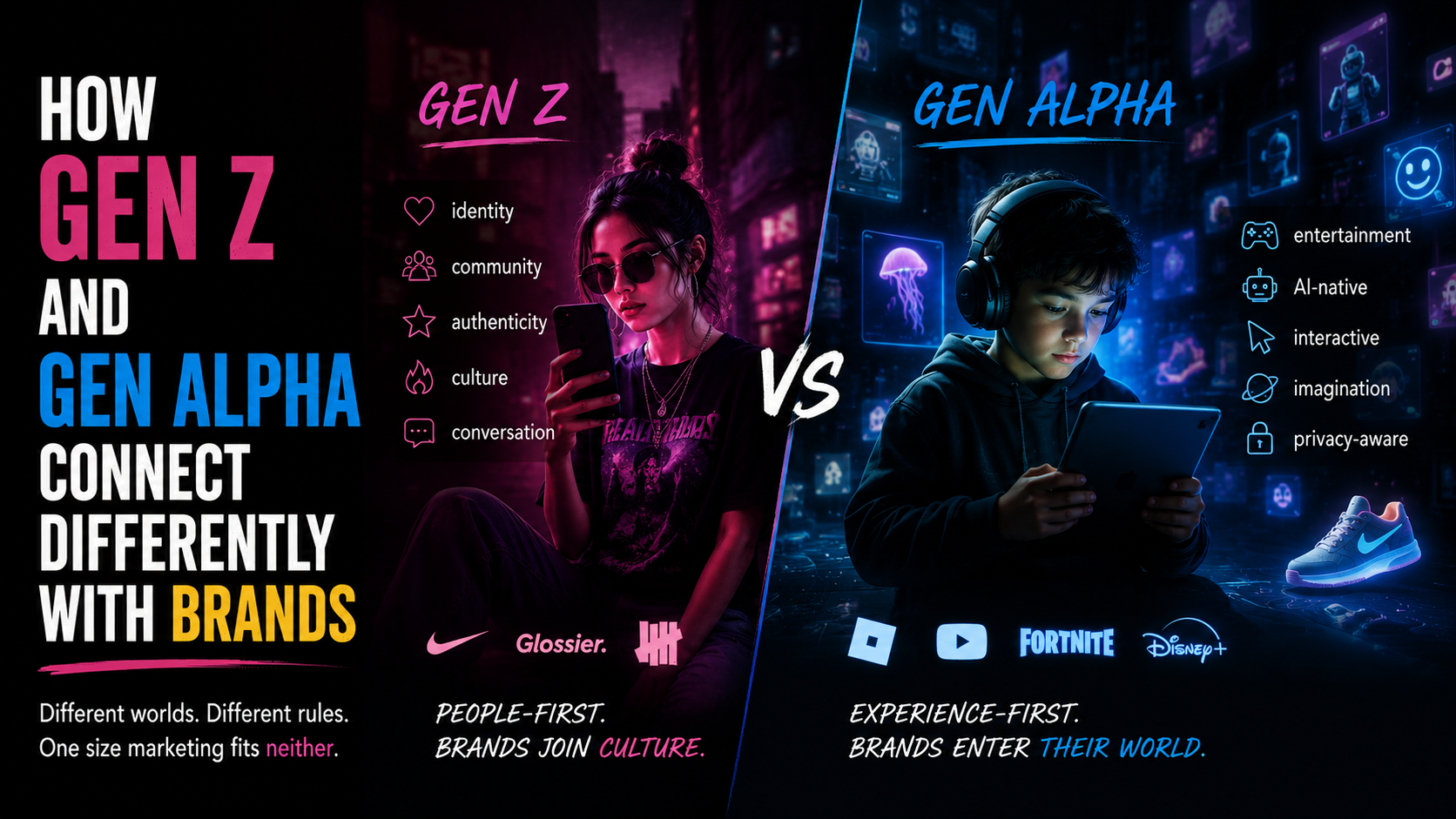
How Gen Z and Gen Alpha Connect Differently with Brands
How Gen Z and Gen Alpha Connect Differently with Brands The next generation of consumers did not grow up in the same internet Marketers keep talking about Gen Z and Gen Alpha like they are the same audience. They are not. One grew up during the rise of social media. The other was born inside algorithmic reality. That difference changes everything. Gen Z remembers transition. Gen Alpha only knows immersion. Gen Z watched the internet become culture. Gen Alpha assumes culture is the internet. Brands treating them identically are already behind. Because the way these generations discover, trust, interact with, and emotionally connect to brands is fundamentally different. And the gap is widening faster than most marketers realise. _______________________________________ Gen Z grew up curating identity Gen Z came of age during the explosion of Instagram, YouTube, Snapchat, and early TikTok. The internet for them was social-first. Profiles mattered. Personal branding mattered. Aesthetic identity mattered. This generation learned to express themselves publicly online. That shaped how they connect with brands. For Gen Z, brands function as identity signals. What you wear, drink, use, stream, and post says something about who you are. This is why Gen Z gravitates toward brands with strong values, cultural positioning, and aesthetic coherence. They do not just buy products. They buy association. The brand becomes part of self-expression. This is also why authenticity became such an overused marketing buzzword. Because Gen Z developed highly sensitive radar for performance. They grew up watching influencer culture evolve in real time. They know when something feels manufactured. Or worse. Desperate. _______________________________________ Gen Alpha is growing up inside algorithmic entertainment Gen Alpha interacts with the internet differently. They are not browsing. They are being fed. TikTok, YouTube Shorts, Roblox, AI recommendations, personalised feeds, gaming ecosystems, and endless algorithmic content streams shaped their digital environment from birth. Their experience of media is less intentional and more immersive. This generation is growing up in a world where discovery is automatic. The algorithm decides what matters. That changes how brands compete. For Gen Alpha, visibility is not about being followed. It is about being surfaced. Which means brands increasingly need to behave like entertainment systems instead of advertising systems. This generation does not separate content, gaming, creators, memes, and commerce neatly. Everything blends together. The brand is not interrupting the experience. The brand is expected to be part of the experience. _______________________________________ Gen Z values alignment. Gen Alpha values engagement. This is one of the most important distinctions. Gen Z often connects with brands through values. Sustainability. Inclusivity. Ethics. Mental health. Social positioning. Whether fully genuine or partially performative, those signals matter because Gen Z sees consumption as an extension of identity. Gen Alpha behaves differently. They are less interested in ideological alignment and more interested in stimulation. Does it entertain me? Can I interact with it? Can I customise it? Can I remix it? Can I play with it? Gen Alpha expects participation. Static brands will struggle with them. _______________________________________ Attention spans did not collapse. Standards increased. One of the laziest narratives in marketing is claiming younger generations have no attention span. That is not true. They have no patience for boredom. There is a difference. Gen Z and Gen Alpha can both spend hours consuming content. But the content must earn attention immediately. These generations grew up inside infinite-scroll competition. Every piece of content fights against millions of alternatives. That environment trained them to filter aggressively. Brands therefore face a brutal reality. You are no longer competing against your category. You are competing against everything. Netflix. TikTok. Gaming. Creators. Memes. Group chats. The entire internet. Which means modern branding increasingly behaves like entertainment architecture. Not traditional advertising. _______________________________________ Gen Z still separates creators and brands Mostly. Gen Alpha often does not. Gen Z witnessed the rise of influencer culture from the beginning. They still distinguish between corporate messaging and creator-driven content. Gen Alpha is growing up in blended environments where creators, platforms, avatars, games, AI personalities, and brands coexist fluidly. To them, a Roblox activation, a virtual skin, a creator collaboration, and a product launch may all feel like part of the same ecosystem. This changes brand strategy dramatically. The old campaign model is weakening. Future brand systems will likely behave more like persistent digital worlds than isolated advertising bursts. Brands are becoming ongoing environments. Not just messages. _______________________________________ Community matters differently now Gen Z helped normalise online communities. Discord groups. Fandoms. Niche TikTok circles. Digital subcultures. Community became central to internet identity. But Gen Alpha is taking this even further. For them, digital interaction is not secondary socialisation. It is socialisation. Gaming spaces, creator ecosystems, virtual experiences, and online collaboration are integrated directly into everyday life. That means brands capable of facilitating interaction gain enormous emotional advantage. The future strongest brands may look less like companies and more like participation platforms. People increasingly want to belong around brands, not merely purchase from them. ________________________________________________________________________________ Aesthetic literacy is now universal Younger generations consume enormous volumes of visual content daily. As a result, their aesthetic expectations are significantly higher than previous generations. Bad branding stands out immediately. Cheap design signals low credibility. Generic content gets ignored instantly. This creates pressure on brands to operate with cultural and visual sharpness at all times. Especially online. Because every touchpoint now acts as branding. Packaging. Comments. Captions. Motion. Memes. UI design. Everything communicates. The brands winning younger audiences understand this intuitively. They build cohesive worlds instead of isolated advertisements. _______________________________________ The biggest mistake brands make with younger audiences Trying too hard. Nothing collapses credibility faster. Gen Z and Gen Alpha both grew up around highly mediated digital behaviour. They recognise forced relevance instantly. When brands chase slang awkwardly, mimic meme culture poorly, or insert themselves artificially into conversations, the reaction is usually brutal. The internet punishes desperation. The strongest brands therefore do something surprisingly simple. They understand their role. Not every brand needs to behave like a comedian. Not every brand should try to become culturally viral. The brands that win tend to understand where they naturally fit inside the consumer's world. Then they execute consistently. _______________________________________ Future brands will behave more like media companies This shift is already happening. The line between brand, entertainment, creator, platform, and community is dissolving. Future successful brands will likely need: • Content ecosystems • Creator partnerships • Community infrastructure • Interactive experiences • Personalisation systems • Digital environments • Ongoing narrative worlds In other words, branding itself is becoming more dynamic. Not static identity. Living systems. This evolution matters especially for Gen Alpha because they are growing up expecting interactivity by default. Passive consumption increasingly feels outdated. _______________________________________ Closing Gen Z and Gen Alpha are not simply younger consumers. They are products of entirely different digital environments. Gen Z connects with brands through identity, values, and cultural alignment. Gen Alpha connects through immersion, participation, and algorithmic engagement. One generation learned to express itself online. The next generation is growing up inside digital ecosystems where the boundary between entertainment, commerce, creators, and brands barely exists anymore. The companies that succeed over the next decade will not merely advertise to younger audiences. They will build environments people want to participate in. Because increasingly, the strongest brands are not being watched. They are being lived inside.
MAY 24, 2026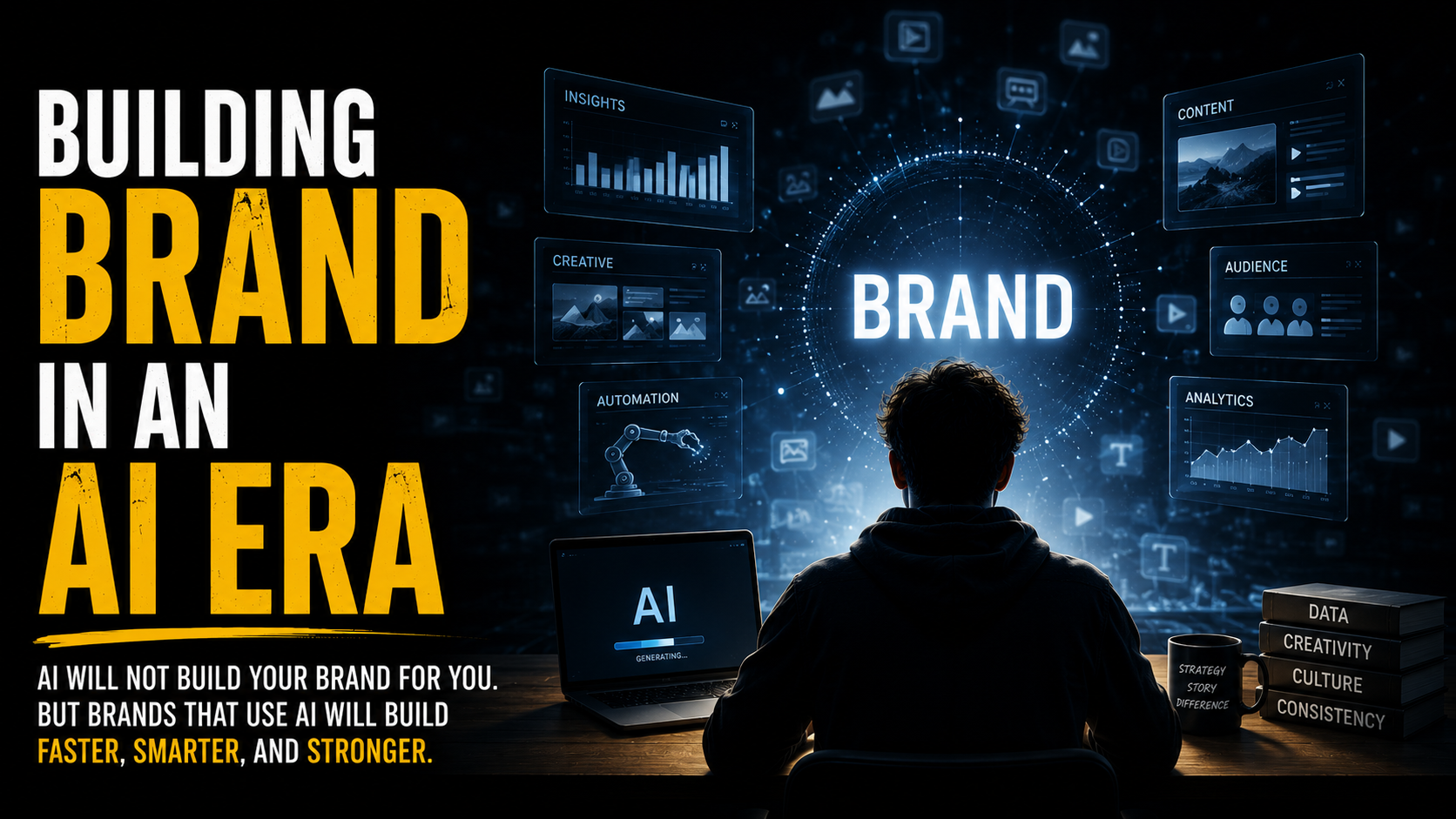
Building Brand in an AI Era AI is about to flood the world with average content
Building Brand in an AI Era AI is about to flood the world with average content This is the part most marketers still do not fully understand. AI is not just another productivity tool. It is a content multiplier. An enormous one. Over the next few years, brands will generate more ads, more visuals, more copy, more videos, more campaigns, and more automated communication than at any point in history. The cost of producing content is collapsing. Which sounds exciting. Until you realise what happens when everyone gains the same capability simultaneously. The internet fills with noise. Not because AI makes bad marketing. Because AI makes average marketing infinitely easier to produce. And when average becomes abundant, distinctiveness becomes priceless. _______________________________________ The scarcity has shifted Historically, production capacity created advantage. The companies capable of producing more content, buying more media, and operating larger creative teams usually dominated attention. AI changes that equation. Execution is becoming commoditised. The new scarcity is no longer production. It is taste. Judgement. Strategy. Distinctiveness. Creative direction. In other words, the tools are democratising. Which means brand itself matters more than ever. Because when everyone can generate content quickly, consumers need stronger signals to decide what deserves attention. _______________________________________ Most AI-generated marketing will look the same This is already happening. Scroll LinkedIn for five minutes. The same polished graphics. The same sterile copy. The same motivational tone. The same hyper-clean AI aesthetics. The same recycled structures. AI systems are trained on existing patterns. Which means average inputs tend to produce average outputs. That creates a dangerous future for brands relying purely on efficiency. Because optimisation without identity eventually leads to sameness. And sameness destroys memory. The brands that survive the AI era will not be the ones generating the most content. They will be the ones generating the most recognisable content. _______________________________________ Distinctive assets become survival systems In a saturated AI environment, distinctive assets stop being optional. They become navigation tools. Consumers will increasingly rely on recognisable colours, visual systems, tone of voice, sonic branding, mascots, typography, and recurring creative devices to filter overwhelming volumes of content. Recognition reduces cognitive load. That matters enormously when feeds become infinitely crowded. This is why the strongest future brands will likely behave less like campaign machines and more like highly consistent sensory systems. Every touchpoint reinforcing memory. Every asset strengthening recall. The brands with weak identity systems will disappear into the algorithmic blur. _______________________________________ AI increases the value of human taste Ironically, AI may elevate human creativity rather than replace it. Because the bottleneck shifts. Generating ideas becomes easy. Choosing the right ones becomes difficult. The future competitive advantage is not prompt writing. It is creative judgement. Knowing what feels culturally sharp. Knowing what feels emotionally resonant. Knowing what should not be generated. That last point matters. Restraint is becoming a premium skill. Just because brands can produce endless content does not mean they should. Volume without meaning accelerates irrelevance. _______________________________________ Brand consistency is evolving Traditional brand guidelines were built for slower media environments. Fixed layouts. Fixed logo rules. Fixed executions. AI changes the scale and speed of adaptation. Brands now need systems capable of producing enormous variation while still feeling unmistakably recognisable. That is a different challenge. The future belongs to flexible identity systems. Consistent signature. Infinite execution. The core assets stay stable. The outputs become dynamic. This is especially important because AI-generated media will increasingly personalise itself in real time. Consumers may see entirely different versions of the same brand depending on platform, context, behaviour, and preference. Without strong underlying identity systems, fragmentation becomes inevitable. _______________________________________ AI will not fix weak strategy Many companies secretly hope AI will compensate for mediocre branding. It will not. AI amplifies whatever system already exists. Strong brands become more scalable. Weak brands become more efficiently forgettable. If your positioning is unclear, AI scales confusion. If your visual identity lacks distinction, AI multiplies sameness. If your communication feels generic, AI produces generic faster. Technology does not solve strategic weakness. It exposes it. _______________________________________ Human connection still matters One interesting paradox of the AI era is that human signals may become more valuable precisely because synthetic content increases. Consumers will increasingly look for proof of humanity. Founder visibility. Behind-the-scenes content. Real voices. Community interaction. Imperfection. Not because people reject AI entirely. But because trust becomes more important when artificial production becomes widespread. This creates an unusual future where brands simultaneously become more technologically sophisticated and more emotionally human. The strongest companies will balance both. _______________________________________ The internet is entering synthetic media overload AI-generated video, AI-generated influencers, AI-generated images, AI-generated music, AI-generated voices, AI-generated articles. The volume will become overwhelming. This changes consumer psychology. People adapt to abundance by filtering harder. Attention becomes even more selective. Which means emotional clarity matters more. Brands must communicate faster. Sharper. More recognisably. The middle ground becomes dangerous. Forgettable brands will vanish quickest because there is simply too much competing material. _______________________________________ Creativity is shifting from production to orchestration This may be the biggest transformation of all. Historically, creative work involved manual execution. Designing. Writing. Editing. Animating. Producing. Increasingly, creative leadership will involve orchestration. Directing systems. Combining tools. Curating outputs. Building coherent brand worlds across enormous volumes of generated material. The role of the creative person does not disappear. It evolves. Much like photography did not kill art. And digital music did not eliminate musicians. The tools change. Taste remains. _______________________________________ The brands that win will feel unmistakably themselves This is the core lesson. In an environment where content becomes cheap, identity becomes expensive. The future strongest brands will likely share several traits: • Strong distinctive assets • Clear strategic positioning • Recognisable tone of voice • Flexible but coherent design systems • Human emotional signals • Cultural awareness • High creative judgement Not because AI replaces branding. Because AI intensifies the importance of branding. _______________________________________ Closing The AI era is not killing creativity. It is killing average. Brands can now generate more content than ever before. But consumers are also filtering more aggressively than ever before. That means future growth will not come from volume alone. It will come from recognisability. Clarity. Taste. Distinctiveness. The brands that thrive over the next decade will not simply use AI efficiently. They will use it while remaining unmistakably human. Because when every company can generate infinite communication, the rarest thing left is a brand people actually remember.
MAY 24, 2026